
First Contact
Coaxing fibers into existence

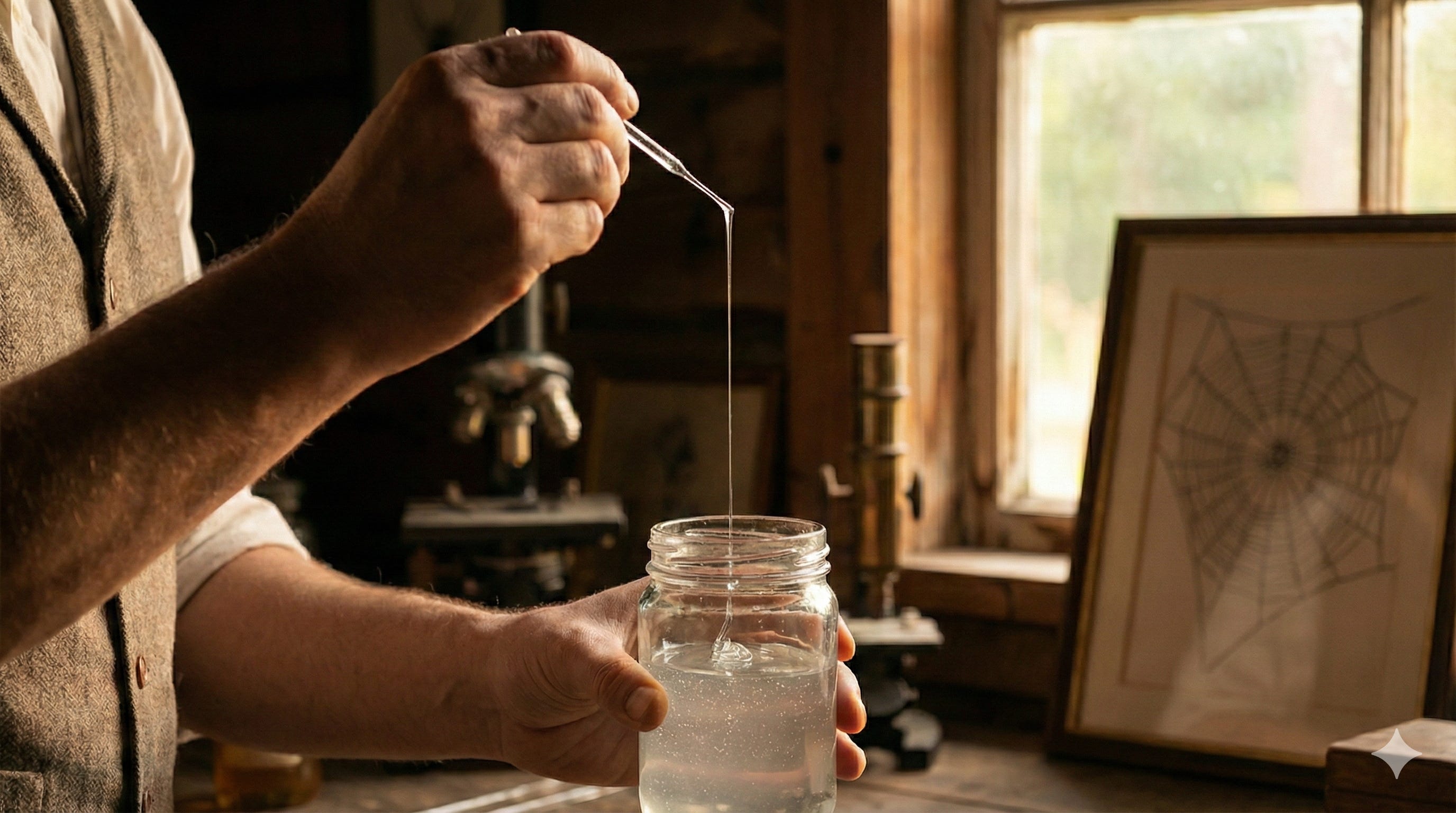
Contact spinning looks simple. You dip a rod or a needle into a viscous solution (the consistency of honey), pull away slowly, and a filament follows you. It’s thin, continuous, almost weightless. It feels like magic, but it’s actually one of the oldest attempts to manufacture a fiber the way life does. Long before we knew proteins fold or that spider silk is a choreography of molecular assembly, someone tried to pull a synthetic fiber from a liquid, by hand.
In the 1850s, a Swiss inventor named Georges Audemars, working without the knowledge that silk was a protein, ground up mulberry bark and leaves (what silk worms eat, cellulose), mixed it with alcohol and esters, and produced the first artificial filament. It wasn’t strong. It wasn’t scalable. But the logic was right: touch, pull, solidify. A small gesture that hinted at an entirely new way of making materials.
The technology didn’t scale at the time and so the patent sat on a shelf.
In the 1880s, a silkworm pandemic swept through Europe. In that era, when you had a biological catastrophe, who do you call? Louis Pasteur of course. Pasteur ultimately solved the epidemic through basic sanitation and quarantine practices. But the breakthrough that would change textiles forever came from his laboratory assistant: Count Hilaire de Chardonnet.
Chardonnet, maybe not the best lab assistant, spilled a solution of nitrocellulose on a table. He left it to dry while he went out to lunch. When he returned and tried to wipe it up, tiny strands formed between the cloth and the surface, pulling into long shiny threads. It was the same logic Audemars had discovered decades earlier, but it ignited a deeper economic motivation. Silk was expensive. Europe needed a replacement. And here, stretched between a rag and a workbench, was proof that a liquid could become a fiber.
Chardonnet devoted the rest of his life to this accident. He refined the process, developed the industrial equipment, and created what would eventually become known as wet spinning: dissolving a polymer, forcing it through a nozzle, and solidifying it in an anti-solvent bath. It worked. It scaled. It led to an entire industry.
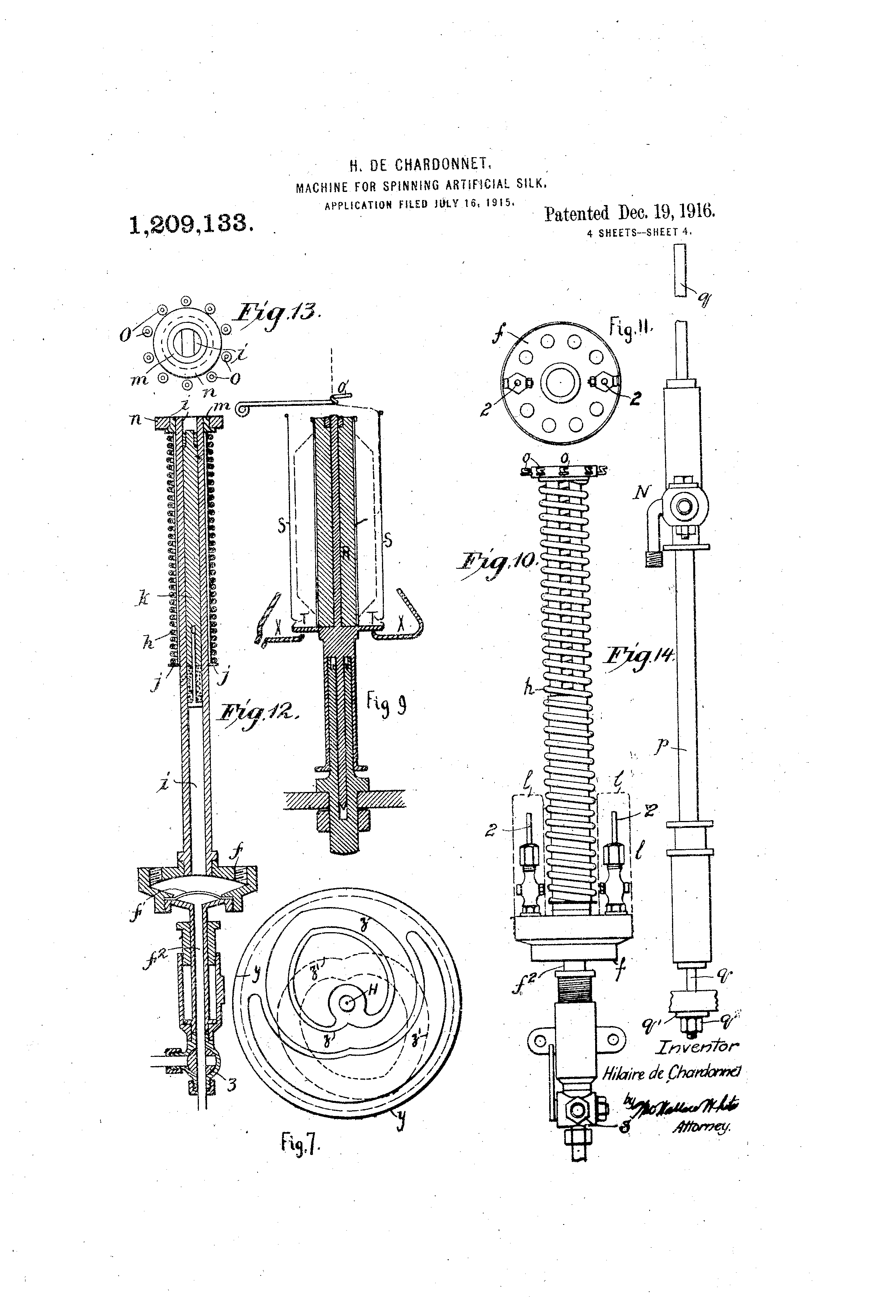
Nitrocellulose did have a few flaws. There were stories of dresses igniting at dinner parties, of entire factories reduced to ash. Eventually, safer cellulose chemistries replaced it, and from those improvements came rayon, and the entire family of regenerated cellulose fibers that are part of modern textiles.
But for proteins such as silks, collagens, and keratins, wet spinning is still the wrong tool. It forces a polymer through a nozzle under pressure, disrupting the very self-assembly rules that give natural fibers their performance. You can get a filament, but not the hierarchical order that makes spider silk extraordinary.
Which brings the story back to contact pulling.
If wet spinning was a detour, contact spinning looks like a return to first principles: a gentle phase transition, tension guiding alignment, molecules organizing under shear the way they do inside a spider’s duct. Today, 3DBioFibR is the world leader in industrial contact pulling, proving that this ancient idea can be reborn at scale. And in our own lab at Impossible Fibers, we’re building prototypes in the spirit of Audemars. We are dipping, pulling, tuning viscosity and alignment, and rediscovering what he glimpsed 170 years ago.
Contact spinning is simple, and almost meditative. But hidden inside that gesture is a radically different philosophy of manufacturing: that high-performance fibers aren’t forced into existence –> they’re coaxed into being. And as we learn how to reliably pull protein fibers, we may find that the future of advanced materials doesn’t lie in the processes we’ve inherited, but in the ones we almost forgot.
Excellent exploration! You might enjoy silk: a world history (great book)…
Meanwhile at Fio’s lab… https://crystalline-halibut-bcd.notion.site/SpiderBot-Final-Project-149cfa0c0f6446188ee2f9bcbd248eff