
Humanity Makes Noodles. Nature Makes Machines.
The spider in your backyard is a wonder of manufacturing capability.


There's a spider in your garden right now that's better at advanced manufacturing than any company on Earth. It keeps a gland full of liquid crystal silk inside its body right up until the moment it's needed to form a fiber. Then, without furnaces or solvents, it converts that liquid into a fiber stronger than steel and saunters away to do it again another day (using only bugs as energy and material supply).
We don't make anything that way.
I've spent a long time looking at the gap between how we make fibers and how nature makes fibers, and I've come to think it's one of the most interesting gaps in materials and manufacturing. It's also widely misunderstood, including by over a century of very smart people who have been trying to close it. So in this article I want to highlight what the spider and other organisms like it are doing that is different from us, why our best attempts to catch up keep failing, and why I think it has finally become solvable.
The Thread That Does Everything

Let’s move away from the spider for a minute (as a model organism, it might not be the best one), and go to the beach. In many places in the world, if you head to where the ocean meets rocky land, you have a good chance of spotting a mussel. These crafty bivalves live at the intersection of pounding waves and fast tides. If you look at how a mussel holds on to the rocks, you’ll find it attached by a handful of fine brown threads. Each of those byssal threads is doing something truly astonishing: anchoring a soft animal (it wears the shell) to a hard, wave-battered surface, all without tearing itself apart.
The mussel doesn't spin a simple noodle out of material; it makes an entire device out of proteins. Near the body, the thread is soft and stretchy, with low enough stiffness to absorb the shock of passing waves. Near the rock, it's stiff (ten times stiffer) so it can transfer the tension into solid stone. In between there's a gradient, a handoff from soft to hard that keeps stress from piling up and tearing at a single interface (a common failure mode in many man-made devices). On top of that, the whole contraption is wrapped in a protective coating several times harder than the core, and if it's pulled beyond its normal length, the fiber itself is self-healing at the molecular level, using reversible metal bonds to dissipate the energy and then re-form. I didn't even mention how it sticks to the rock, but it does that too.
This one little brown thread contains a stiffness gradient, self-healing, an adhesive end, and an abrasion coating, all within a few millimeters, and all controlled by proteins. The byssal thread is a machine, not just a simple fiber. By comparison, our advanced fibers look like simple noodles.
Nature’s Assembly Line
The mussel and the spider are just two examples of an incredible range of creatures that make extracellular fibers as complex as any device. When I say “extracellular” I’m putting a lot of weight on that term, because it means there’s no cellular involvement in the direct phase transition of the fiber. That matters: this means that going from the fluid phase “dope” to the solid phase of the fiber is just chemistry and physics, with no tricky cells needed. Because of this I think we have a decent chance of understanding it today, and maybe even transitioning those same tricks to industrial-scale applications that also run on chemistry and physics.
One trick in particular I’ve grown fond of is what I’ll call “encapsulation” for this conversation. This is where the protein in its liquid phase is controlled in some fashion by a boundary layer. Different organisms have settled on different mechanisms, from liquid crystal states, to coacervates, to maybe my favorite and the simplest: vesicles. A vesicle can be thought of as just some fluid wrapped up in a lipid (a fat). In our case, the fluid is the precursor spinning protein called ‘dope’.
These encapsulated dopes are quite handy. They can be stored without triggering, which matters a lot. It would be quite unfortunate for the spider if its silk gland simply didn’t work because it was clogged by silk forming where it shouldn’t. Encapsulated dopes can be sorted and moved to the right place at the right time. The mussel for example uses encapsulated dopes (vesicles) to put just the right protein in just the right place to build its thread-like device. What’s more, once the dope is encapsulated you can control when to react and trigger, by popping or releasing agents at exactly the right moment. The velvet worm has mastered this by encapsulating the reactant or trigger into a slime it sprays on prey - as the prey struggles, more vesicles break, trigger more fiber formation and further entrapping the prey. Encapsulation provides organisms with control over materials creation.
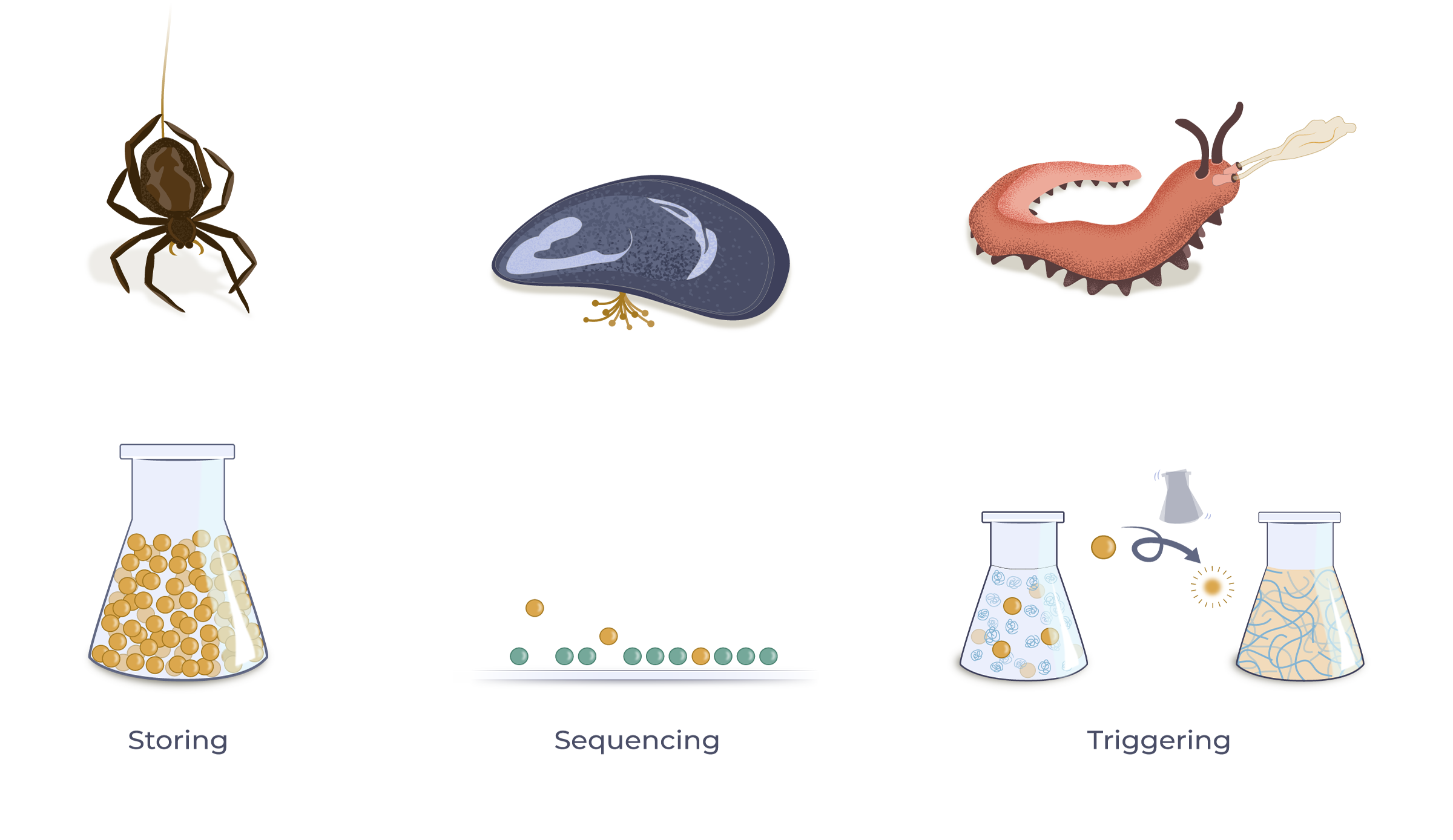
Interestingly, biologists Matthew Harrington and Anna Rising, in a review I keep close at hand, describe these manufacturing tricks as “similar to microfluidic droplet processing.” Getting to the principles behind the biology you find the same manufacturing strategy across not just spiders and mussels, but multiple organisms that make extracellular fibers:
Store the reactive material in condensed phases (in our case encapsulation).
Organize, sort, and assemble the material in fluidic form.
Control the reaction trigger when the reactive material is in the right place at the right time.
Once you start looking for this pattern in biology, you find it everywhere life makes a fibers, and almost nowhere in how we make one.
The Three Waves of Protein Fibers
We have been chasing how to make silk for over 300 years, inspiring both of our existing industrial spinning methods of melt and wet spinning. However, for proteins I think it makes sense to break it down into 3 waves over the past 100 years.
The First Wave
The rally cry of “let’s use proteins” for fibers dates all the way back to Benito Mussolini in the 1920s, as part of a push for a policy of autarky, or self-sufficiency.
Italian chemist Antonio Ferretti recognized that casein, an abundant protein from the milk industry, could be turned into a fiber through wet-spinning along with formaldehyde. The fiber he produced was eventually dubbed Lanital (a combination of the Italian word for wool, “lana,” and Italy), and it was pitched as a replacement for imported wool.
Around the same time, Henry Ford became deeply fascinated (obsessed, maybe) with soybeans, and in the 1930s Ford Motor Company invested in turning soy into physical products. They produced a soybean-based fiber used in car upholstery and clothing, and Ford famously wore a suit made of soybean fiber.
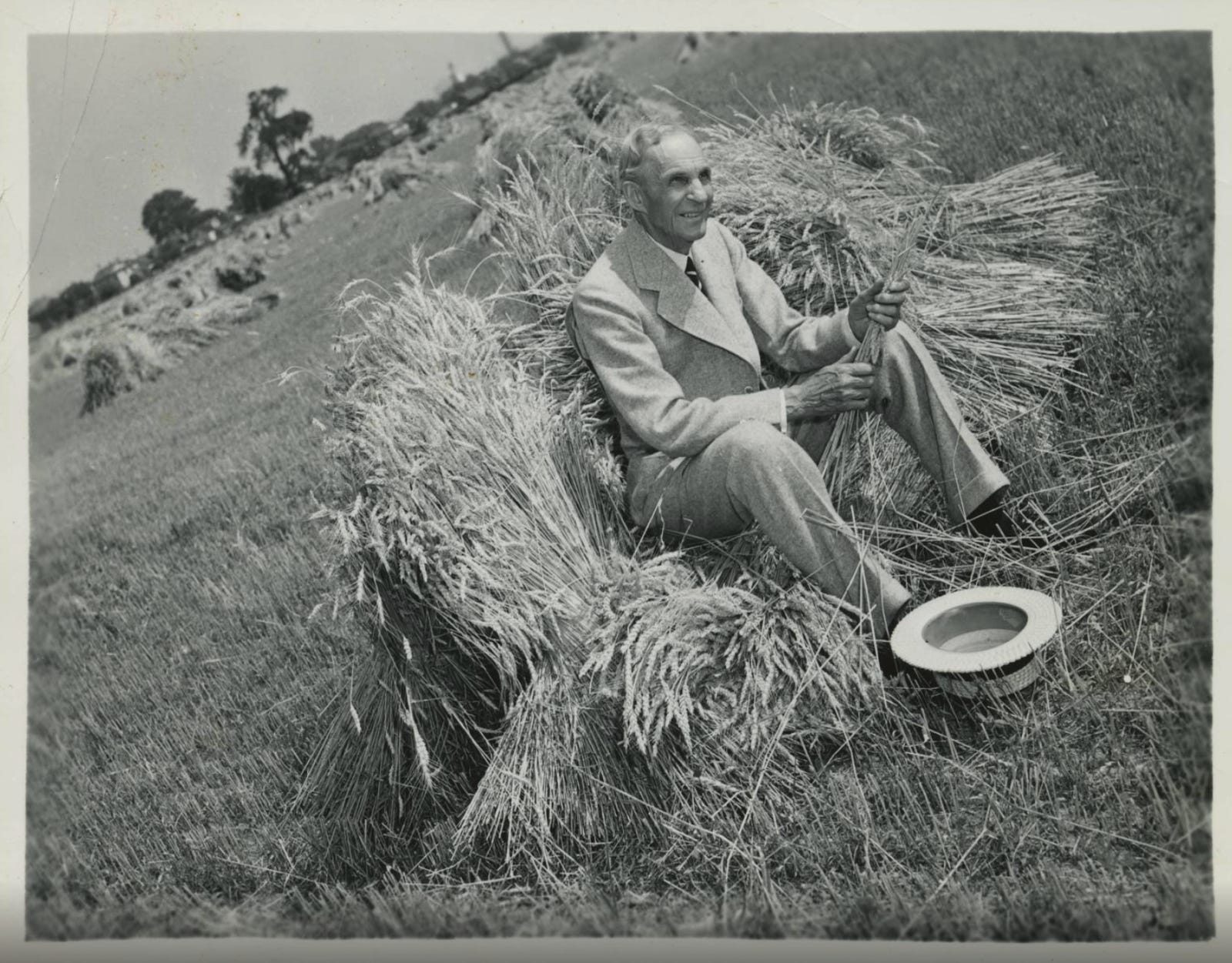
Despite the initial interest, neither Ford’s soy fibers nor Ferretti’s Lanital gained traction. In general they weren’t as durable as wool or other natural fibers, they lost strength when they got wet, and they tended to mold quickly. These weren’t impossible problems to solve (as we will see), but after WWII polyester arrived on the scene. Polyester and Nylon, as fossil-fuel-based fibers, were inexpensive and had impressive performance. They quickly overtook the market, and research and development for protein fibers slowed to a crawl.
The Second Wave
DNA was the name of the game in the late 1990s and early 2000s, and once we realized we could start to engineer organisms, we jumped to the idea of "Spider Goats” (naturally). What if we could directly use proteins we know are super strong like spider silk? Randy Lewis's lab at USU famously engineered goats to produce milk that contained spider silk. Soon after, we were growing silk in bacteria, and companies started to brew proteins and turn them into fibers. All with the idea that if we could just find the right protein, we could spin the next wonder fiber. AmSilk, Bolt Threads, Spiber, and others all did amazing science to build this capability and actually make fibers out of these proteins, and some of them are still standing. But a pattern became clear that should have been the headline: making the molecule turned out to be the "easy" part. Spinning that molecule into a fiber that actually performed, and at a cost that worked in the market, was brutal.
“When you ask a goat, or you ask a bacteria to produce spider silk for you, all you get is the raw protein powder, then you have to formulate it into a fiber or some other material form….” — Justin Jones, PhD, Utah News, 2022
The Third Wave
The third wave is where we see costs and scalability start to take traction. As is often the case in materials, it’s not the ability to make the material that matters, it’s the ability to make it at scale.
For protein based materials, we are rapidly approaching scale.
The cost of protein production for structural fibers has dropped from roughly $1,000/kg to $100/kg in the past five years, and is expected to reach commodity prices of $30–50/kg by 2030 (or sooner), with continued progress toward existing food-grade protein production around $10–20/kg as the market matures.
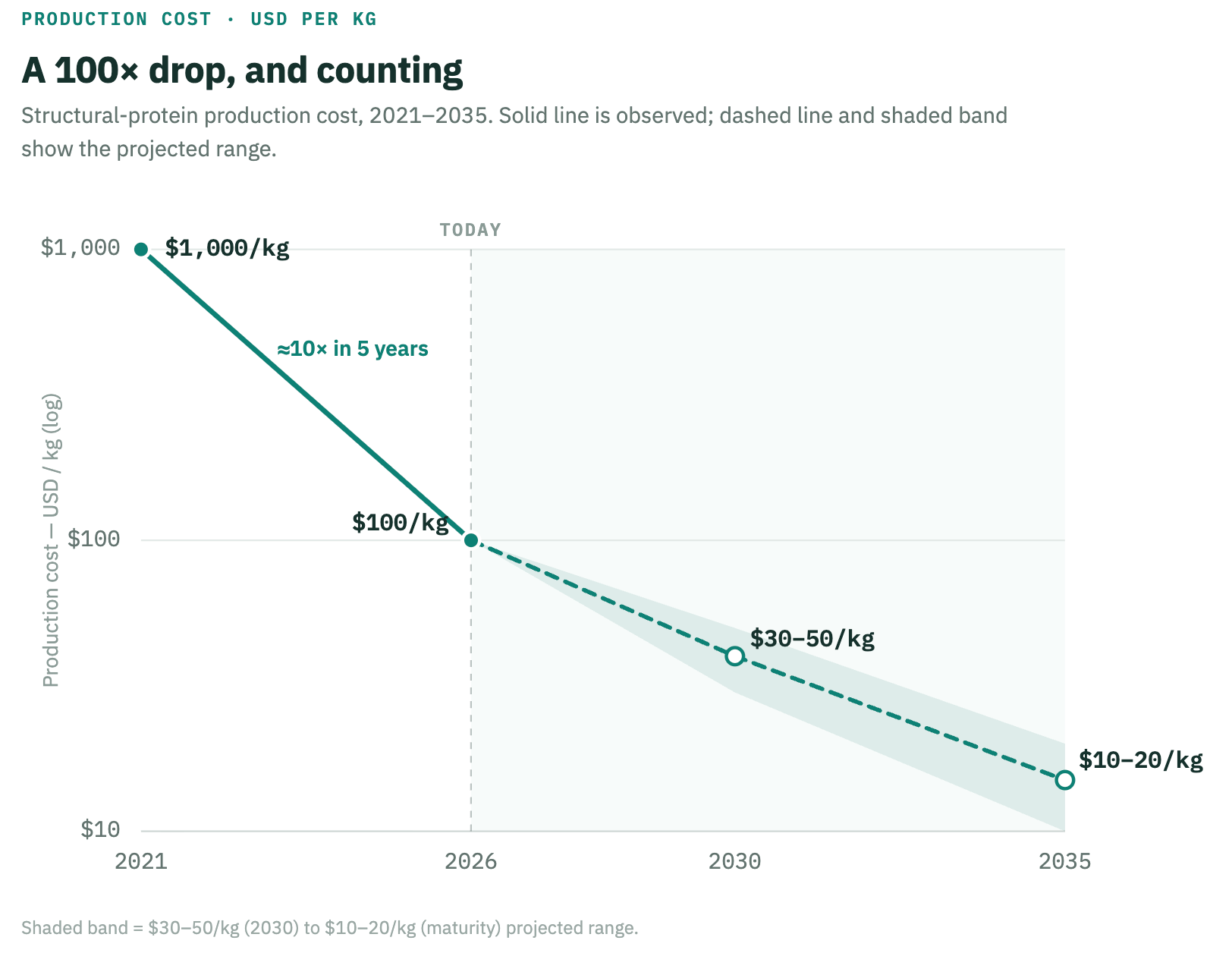
For comparison Cashmere is $120-150/kg, Silk is $40-100/kg, Nylon is $3/kg, Polyester hovers around the $1/kg. This means that pure protein based fibers are already matched with prices of luxury fibers, and rapidly approaching costs of today’s more traditional materials. I don’t expect proteins to meet the price points of plastics, however what I do expect is that protein fibers will unlock a world of new capabilities and performance that currently don’t exist in the market.
This is because, in addition to the rapidly changing cost curve. AI protein design has shifted what is imaginable to produce. Today, we can build proteins with specific functions in mind, and we are increasingly able to design properties that sit beyond what nature has explored.
Lab automation is poised to unlocking predictability, generating consistent, repeatable data at volume, which is what lets us predict larger-scale outcomes that connect multiple levels of design hierarchy and complexity. We see hints of this already in drug-design where consistent automated labs are able to build the data needed for ML training that enables turning what used to take years and hundreds of millions of dollars, into a weekend project.
Together these trends are a forcing function that make protein based material an inevitable part of our future technology- but we are still missing a few tools.
Building the Missing Tools
At the Impossible Fibers Lab at Astera Institute, we believe the next wave of protein fibers will scale what’s possible, and what is missing is the tools to build with proteins – to create protein native fabrication technologies. To tackle this we have been creating a micro-fluidics technology platform that learns from nature’s strategies, opening the door to better understanding dope chemistry and phase transition for protein-based materials, in other words, a manufacturing process that is native to proteins.
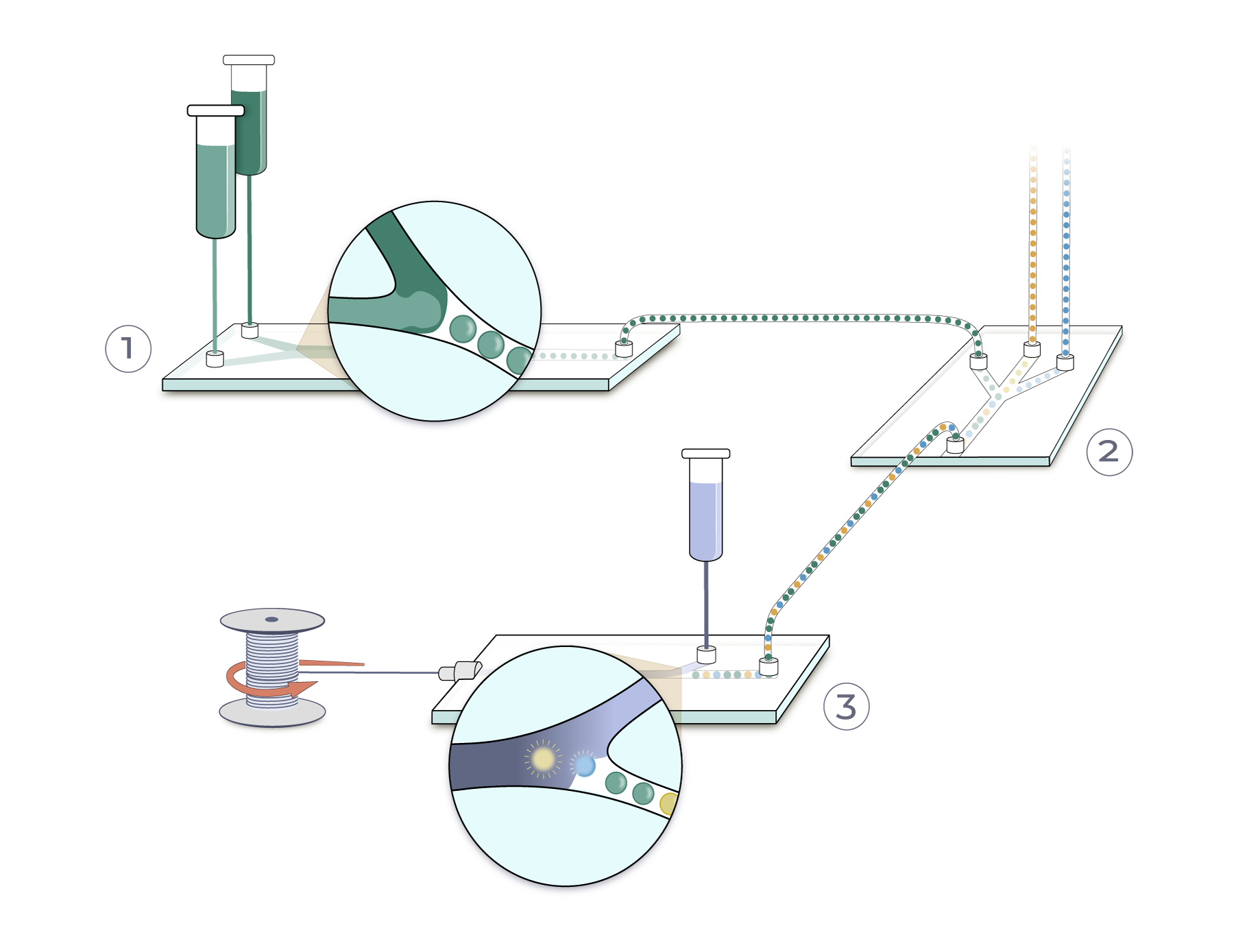
1 - Micro-fluidic Dope Encapsulation is the technology we’ve built explicitly to create encapsulated spinning dopes. We’ve been honing a stainless-steel micro-fluidics fabrication strategy that lets us rapidly iterate micro and milli-fluidic designs that will work with the harsher chemistries often needed to bring proteins into solution.
2- Micro-fluidic Sorting and Organizing lets us “program” the spatial and temporal control of encapsulated droplets through a spinning or materials system. This concept is how we can put the right protein in the right place at the right time to create materials that are otherwise impossible.
3- Micro-fluidic Spinning concept gives us phase-change control over spinning dopes. Tuning the trigger and the cross-linking of proteins allows far greater control of molecular assembly, which has been shown a key to high-performance outcomes of protein-based fibers.
Taking our cues from nature, we believe this micro-fluidic system is an important toolset that can finally start to bridge the gap, where the next generation of fibers can reach the performance we see in the natural world, as well as take us in entirely new directions. In the next few months we will be sharing more about this fluidic system, as well as what we have discovered. You can follow along here, or on our community Zenodo page where we first publish papers, methods, and ongoing work.